


Sorloth, Haaland and Norway's World Cup Exit: The Risk of Playing Two Strikers
Alexander Sorloth had Erling Haaland free in a 2-on-1 and went alone. Norway lost 2-1 to England and went home. It explains everything about the challenge of pairing two natural strikers.


In the 44th minute at Hard Rock Stadium in Miami, Norway led England 1-0 in a World Cup quarterfinal when Martin Odegaard played a pass through to Alexander Sorloth. Erling Haaland was running free to Sorloth's left, with only John Stones anywhere near them and Declan Rice tracking back too far behind to matter. Two against one, ball at Sorloth's feet; you could say it was the simplest decision in football.
Sorloth held the ball, slowed, tried to beat Stones himself, and saw his shot blocked and gathered by Jordan Pickford. Haaland stood with his arms wide open. England equalised through Jude Bellingham just before halftime, with a goal surrounded by controversy after the ball appeared to strike a suspended camera wire above the pitch before possession changed, an incident the officials missed.
Norway had a goal disallowed for offside in the second half, hit the crossbar in extra time, and lost 2-1 to a Bellingham brace. Their first World Cup since 1998, their best run in the tournament's history, was over.

Sorloth finished the tournament with zero goals and zero assists across five appearances. Haaland finished with seven goals and had carried Norway to a place nobody expected them to reach. And in the one moment where the pass to him was obvious, it never came.
That moment explains something that coaches at every level keep running into when they decide to play two strikers.
What two strikers are supposed to do
The idea behind a two-striker system is sound. You give the opposition two different physical problems in the same area. One striker occupies a centre-back while the other runs beyond him. One drops to link play while the other stays high and stretches the defence. When both press together, the goalkeeper runs out of safe options.
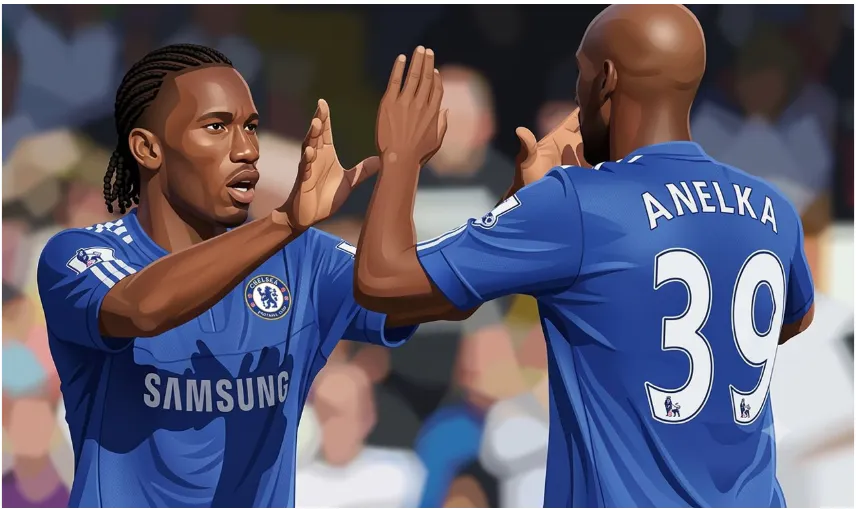
The best versions of this setup have produced some of football's most productive partnerships: Drogba and Anelka at Chelsea under Ancelotti, Lewandowski and Muller at Bayern in many seasons. What made each of those pairs work was that the two players were different types. One provided what the other could not. The partnership created things that neither player would have created alone.
Haaland and Sorloth are not exactly different in that sense. They are both large, physical centre-forwards who attack space, hold up play, and are built to finish. When you put two players with the same profile in the same forward line, the system does not automatically become a problem but the demands on both players to understand their roles in every situation become much harder to meet, especially in high-pressure moments.
When Sorloth received that ball, his brain processed what every striker's brain processes first: the goal. His instinct said he could score. The pass to Haaland meant Haaland scored, and for a striker who had gone the whole tournament without a goal, that thought is harder to override than it sounds at full sprint, in a quarterfinal, in Miami's heat, with everything at stake.
In a report by Goal, Sorloth's coach Stale Solbakken pointed to the physical reality afterwards: "He sprints at full speed for 40-50 metres, and then he looks for the exact time he should release it to Erling. He doesn't find it, and then it runs out."
That is a generous reading, but it is not wrong. The decision dissolved in the chaos of the moment.
A winger coming in that same position almost always passes. That is not because wingers are more intelligent or more selfless. It is because their instinct, built through years of playing wide and creating, tells them the cut-back is the right move. Strikers are trained to see the net first. That is what makes them good at what they do. But in a two-on-one, that instinct becomes the exact thing that can end a World Cup run.
When it goes wrong, and when it does not
In the Argentina versus Switzerland quarterfinal played the same day, Breel Embolo had the ball in the Argentina box with Dan Ndoye in a better shooting position. Embolo passed. Ndoye took a touch to control instead of shooting first time, and Argentina scrambled back to block. The goal did not come and Switzerland lost 1-0. Different moment, different players, but the points are the same: decisions in front of goal, in fractions of a second, decide everything at this level.
The two-striker system where the coaching around the partnership is detailed enough to make instincts align.
Norway, playing their first World Cup in 28 years with a squad built primarily around getting the best out of Haaland, may simply not have had that same depth of preparation for what happens when Sorloth arrives first.
Norway go home having exceeded every reasonable expectation. They beat Brazil in the round of 16, reached a quarterfinal for the first time in their history, and gave Haaland a tournament stage where he was among the top scorers alongside Messi and Mbappe on eight goals each. The Viking rows will not appear at a World Cup until at least 2030 and the pain of Miami will take a long time to fade.
But the lesson from that 44th minute is not really about Sorloth, and it is not even just about Norway. It is about what happens when the instinct of a striker and the logic of a situation pull in opposite directions. Playing two strikers can be brilliant. It can stretch teams, create overloads and produce goals that a single forward system never generates. It can also put you in a moment where the most natural thing for one of your forwards to do is the exact thing that costs you a semifinal.
Those are the little things that separate quarter-final exits from historic runs, not the tactics drawn up before kickoff, but the decisions made in seconds, on the pitch, when there is no time left to think.
SEE ALSO

The Haaland question: Does a striker need more than goals?
Haaland’s scoring brilliance is undisputed, but modern football demands more. Can City’s striker impact the team beyond the box?

Pep Guardiola vs Sir Alex Ferguson: Football's greatest managers compared
Trophies, records, legacy, players developed. A full breakdown of where Pep Guardiola and Sir Alex Ferguson stand in the argument for the greatest football manager of all time.

CAF, Senegal and Morocco's AFCON 2025 final controversy: how it ended up at CAS
Senegal paraded the AFCON trophy two days after filing a CAS appeal, while Morocco insist the case is closed. Here's a breakdown of how the 2025 AFCON final controversy reached an international arbitration tribunal and what happens next.

France's new Ligue 3 explained: What it is, how it works and why it matters
France's Championnat National becomes Ligue 3 from the 2026-27 season, making it the country's first fully professional third-tier league. Here is a full explainer on the format, governance, broadcast deal, salary cap and what changes for clubs below.
Comments (0)
Latest Posts

Pep Guardiola vs Jose Mourinho: Who Is the Better Tactical Coach?

FIFA Ineligible Player: Forfeit, Fine and the 24-Hour Protest

Harry Kane at 125 Caps: How England’s Captain Keeps Breaking Records

Liverpool’s Anfield Advantage vs Man City’s Off-Field Noise

Ronaldo Retirement: What Portugal Will Look Like Without Their GOAT

The Extended International Window Is Already Hurting Clubs More Than It Helps Players
🔥 Most Read
- 1Goals, Trophies and Loyalty: Inside the World of Lionel Messi
- 2FIFA World Cup 2026 Prize Money: How Much Spain, Every Team, and Player Won
- 3Possession football is ruining the excitement of the sport
- 4Mo Salah, Trabzonspor and the Turkish Super Lig: Everything You Need to Know
- 5Everything to Know About Christos Tzolis, Arsenal’s Premier League Debutant
- 6Real Madrid, Arsenal & Vinicius Jr: How Image Rights Work in Football
More from this Author

Infantino, Manchester City, and FIFA Presidency: Why Arsene Wenger?

Kane, Haaland and Osimhen: What Makes a Striker the Best in the World?

Eberechi Eze Stats and Biography: Progress or Regression?

Manchester City 115 Charges Ruling: 3 Reasons They May Not Be Punished As You Expect

Lamine Yamal Childhood in the Spotlight: Inside a Modern Prodigy’s Rise
